THE COMPLETE ROUTE
Learning Journey
Welcome to the Course Rider. Land, fasten your seat belt and ride eleven milestones from orientation to capstone — with pit stops, focus checks and a memory verse for every stage.
- Start: Orientation — Before Day 1, 45 min.
- Stop 1: AI Fundamentals and Foundations — Days 1–2, ≈3 hours.
- Stop 2: Data Fundamentals and Foundations — Days 3–4, ≈3 hours.
- Stop 3: Python, Data Tools and Model Foundations — Days 5–7, ≈4 hours.
- Stop 4: Machine Learning — Days 8–10, ≈4 hours.
- Stop 5: Deep Learning and Neural Networks — Days 11–12, ≈3 hours.
- Stop 6: Transformers and Large Language Models — Days 13–14, ≈3 hours.
- Stop 7: Generative AI and Model Adaptation — Days 15–16, ≈3 hours.
- Stop 8: Embeddings and RAG — Days 17–18, ≈3 hours.
- Stop 9: MCP Connector Bridge — Days 5, 14 and 17–20, ≈2 hours across the programme.
- Stop 10: AI Agents, MCP and Enterprise AI — Days 19–20, ≈3 hours.
- Finish: Capstone, Deployment and Continuous Improvement — After Day 20, ≈6 hours.
SELECTED STOP DETAILS
CURRENTLY VIEWING
START
Orientation
Before Day 1 · Fundamental · 45 min
Orientation stage
Understand how this programme connects Data, Models, Machine Learning, Deep Learning, Transformers, LLMs, Generative AI, RAG and Agents into one complete enterprise AI system.
WHAT YOU WILL LEARN
- Programme overview and learning outcomes
- Required tools: Python, Jupyter, VS Code
- Student baseline self-assessment
- Project Studio introduction
- How assessment, badge and certificate work
CONCEPTS COVERED
PROJECT STUDIO CONNECTION
Choose the enterprise scenario your Project Studio build will follow for the whole programme.
STAGE OUTCOME
Know the route, the tools and the project you will build across twenty days.
Pit stop: Step away for ten minutes. Recall beats rereading.
Focus radar: Name three things you can now explain out loud.
Checkpoint flag: Log one note in your Project Studio before moving on.
CURRENTLY VIEWING
START
Orientation
Before Day 1 · Fundamental · 45 min
Orientation stage
Understand how this programme connects Data, Models, Machine Learning, Deep Learning, Transformers, LLMs, Generative AI, RAG and Agents into one complete enterprise AI system.
WHAT YOU WILL LEARN
- Programme overview and learning outcomes
- Required tools: Python, Jupyter, VS Code
- Student baseline self-assessment
- Project Studio introduction
- How assessment, badge and certificate work
CONCEPTS COVERED
PROJECT STUDIO CONNECTION
Choose the enterprise scenario your Project Studio build will follow for the whole programme.
STAGE OUTCOME
Know the route, the tools and the project you will build across twenty days.
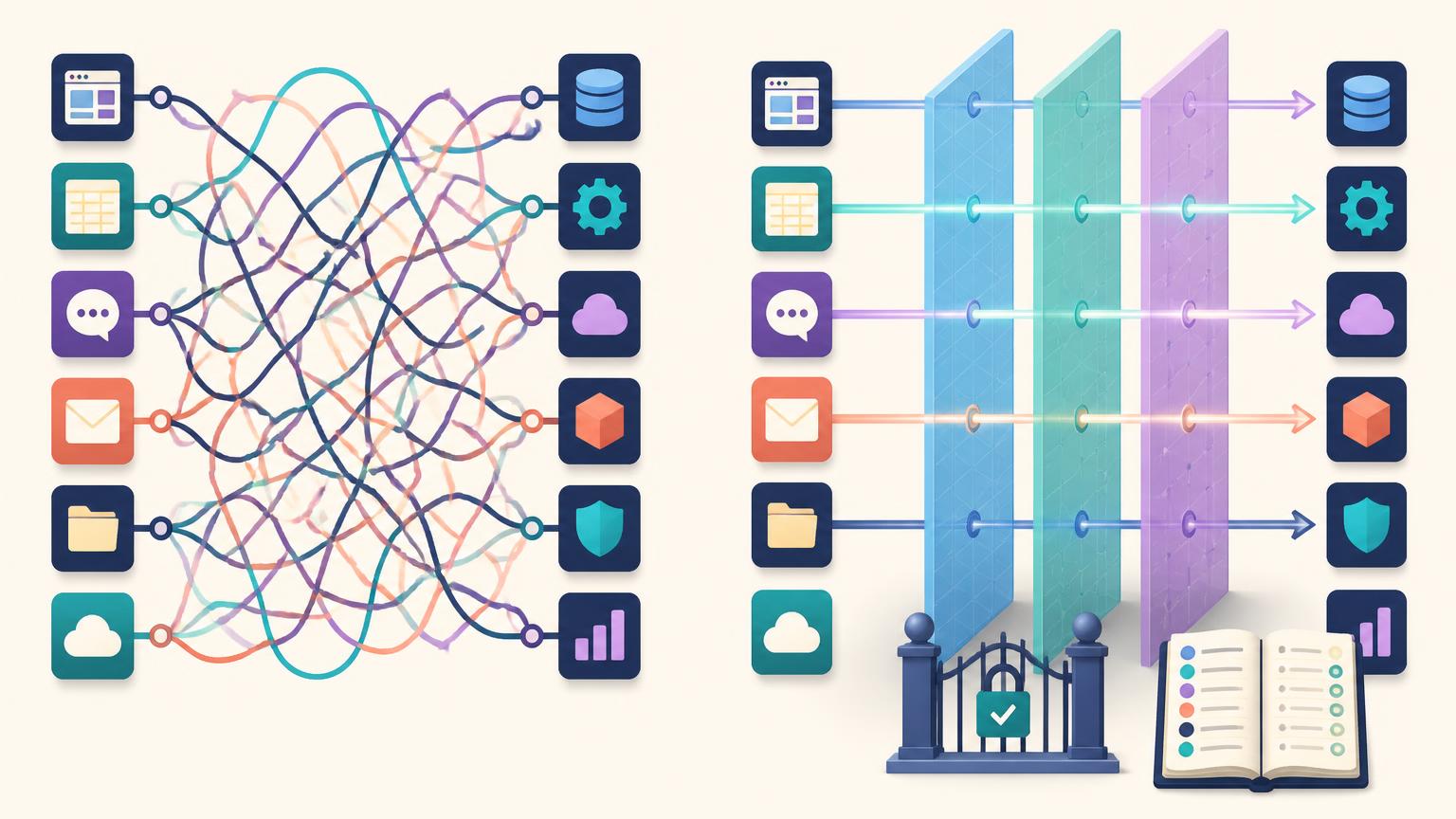
VISUAL TOUR · 3:00
The Universal Connector, in three minutes
The repeated-integration problem.Every application × every system = another bespoke integration to build and maintain.
Memory verses
Memory verses
One short line per milestone — small enough to remember today, strong enough to explain the whole concept tomorrow. Flip a card for the motivation behind it.
Advanced concept path
ADVANCED CONCEPT PATH
From raw data to autonomous action
Six layers, each consuming the output of the one before it. Select any node to see what it means and where it sits in the chain.
FOUNDATION LAYER
Business problem
The decision the system must improve, with a measurable target.
END-TO-END CHAIN
Lifecycles you will run
Every stage lists its inputs, activities, outputs, tools, the common mistake and an illustrative industry case.
PROCESS FLOW
AI system lifecycle
From a business problem to a monitored, governed system.
A framing step converts a vague ambition into a testable objective: who decides, how often, what a good outcome looks like and what the cost of an error is. Without it, every later technical choice is unfalsifiable.
INPUTS
- Stakeholder interviews
- Current process description
- Baseline performance
ACTIVITIES
- Define the decision
- Agree a success metric
- Estimate error cost
OUTPUTS
- Problem statement
- Success metric
- Scope boundary
TOOLS
- Workshops
- Decision records
COMMON MISTAKE · Building a model for a decision nobody actually makes.
INDUSTRY · Hypothetical: a telecom operator frames churn as 'which accounts to call this week', not 'predict churn'.
PROCESS FLOW
RAG implementation lifecycle
Indexing private documents, then answering with cited evidence.
Parsers extract text, headings and tables while preserving the source path, owner, date and permission label so retrieved evidence can always be attributed and filtered.
INPUTS
- PDFs, documents, pages
- Permission model
ACTIVITIES
- Extract text
- Preserve structure
- Attach metadata
OUTPUTS
- Normalised documents
TOOLS
- Document parsers
- OCR
COMMON MISTAKE · Losing headings so chunks become context-free fragments.
INDUSTRY · Hypothetical: an HR team indexes policy PDFs with department and effective-date metadata.
PROCESS FLOW
Agent workflow lifecycle
Goal to business action, with a human in control.
Goals are scoped in advance. An agent with an open-ended objective and broad credentials is an operational risk, so the goal is expressed as a task type with explicit limits.
INPUTS
- User request
- Policy scope
ACTIVITIES
- Parse intent
- Check scope
OUTPUTS
- Bounded goal
TOOLS
- Intent classification
COMMON MISTAKE · Accepting goals outside the approved task catalogue.
INDUSTRY · Hypothetical: a delivery team allows ticket creation but not customer refunds.
Every domain in three phases
Fundamentals, Foundations and Application — the same academic ladder applied to each subject in the programme.
THREE-PHASE FRAMEWORK
Artificial Intelligence
What AI names, how AI systems are assembled, and how they are governed in production.
- PHASE 1
Fundamentals
What intelligence and Artificial Intelligence mean, and why the field exists.
- Intelligence and perception
- AI versus automation
- AI versus analytics
- Narrow AI, AGI, ASI
- PHASE 2
Foundations
The families of techniques and the anatomy of a working AI system.
- Symbolic and statistical AI
- Machine Learning and Deep Learning
- Data, model, inference, feedback
- AI system lifecycle
- PHASE 3
Application
How AI is delivered, evaluated, governed and trusted in an enterprise.
- Use-case selection
- Evaluation and monitoring
- Human oversight
- Responsible AI policy
THREE-PHASE FRAMEWORK
Data
From raw values to governed, retrievable enterprise knowledge.
- PHASE 1
Fundamentals
The vocabulary of data before any tooling.
- Data, information, knowledge
- Values, fields, records
- Datasets and schemas
- Measurement scales
- PHASE 2
Foundations
Classification, quality and where data lives.
- Structured to unstructured
- Quality dimensions
- Lifecycle and governance
- Databases, warehouses, lakes, vector stores
- PHASE 3
Application
Turning data into decisions and grounded answers.
- Cleaning and feature engineering
- Analysis and reporting
- Machine Learning inputs
- RAG corpora and business decisions
THREE-PHASE FRAMEWORK
Models
A model is a learned function with a lifecycle, not a file.
- PHASE 1
Fundamentals
What a model is and what it consumes.
- Inputs, processing, output
- Features and labels
- Prediction versus rule
- Parameters versus hyperparameters
- PHASE 2
Foundations
How a model is built honestly.
- Train, validation, test
- Leakage and baselines
- Generalisation
- Model selection
- PHASE 3
Application
Serving and maintaining the artifact.
- Packaging and registries
- Inference APIs
- Monitoring and drift
- Retraining policy
THREE-PHASE FRAMEWORK
Machine Learning
Learning patterns from data, then defending the result with evidence.
- PHASE 1
Fundamentals
Learning from data instead of hand-written rules.
- Supervised learning
- Unsupervised learning
- Reinforcement learning
- Task types
- PHASE 2
Foundations
The mechanics behind a trained model.
- Features and labels
- Algorithms and training
- Evaluation metrics
- Bias and variance
- PHASE 3
Application
Machine Learning inside a business system.
- Pipelines and APIs
- Deployment
- Monitoring and drift
- Retraining and business integration
THREE-PHASE FRAMEWORK
Deep Learning
Layered representation learning, from a single neuron to a trained network.
- PHASE 1
Fundamentals
The artificial neuron.
- Inputs and weights
- Bias
- Activation functions
- Why depth helps
- PHASE 2
Foundations
How a network actually learns.
- Layers and forward propagation
- Loss functions
- Backpropagation
- Gradient descent
- PHASE 3
Application
Architectures and frameworks in practice.
- CNNs for vision
- RNNs and LSTMs for sequence
- Regularisation
- TensorFlow, Keras, PyTorch
THREE-PHASE FRAMEWORK
Transformers
Attention replaced recurrence and made modern language models possible.
- PHASE 1
Fundamentals
Turning language into numbers.
- Tokenisation
- Token IDs
- Embeddings
- Positional information
- PHASE 2
Foundations
The attention mechanism.
- Query, Key, Value
- Self-attention
- Multi-head attention
- Transformer block
- PHASE 3
Application
Encoders, decoders and downstream use.
- Encoder versus decoder stacks
- Pretraining objectives
- Context windows
- Serving considerations
THREE-PHASE FRAMEWORK
Large Language Models
Next-token prediction at scale — powerful, and confidently wrong when ungrounded.
- PHASE 1
Fundamentals
What an LLM is and is not.
- Next-token prediction
- Statistical generation, not reasoning like a person
- Prompt and completion
- Context window
- PHASE 2
Foundations
How outputs are shaped.
- Pretraining and alignment
- Sampling: temperature and top-p
- System and user roles
- Hallucination causes
- PHASE 3
Application
Building on an LLM responsibly.
- Grounding and citations
- Evaluation harnesses
- Cost and latency
- Safety and logging
THREE-PHASE FRAMEWORK
Generative AI
Producing new artefacts under constraint, with review built in.
- PHASE 1
Fundamentals
Prediction versus generation.
- Discriminative versus generative
- Modalities
- Prompt anatomy
- Determinism limits
- PHASE 2
Foundations
Controlling generation.
- Structured output
- Prompt chaining
- Few-shot patterns
- Guardrails
- PHASE 3
Application
Generation inside a product.
- Templates and brand rules
- Human review
- Provenance
- Cost control
THREE-PHASE FRAMEWORK
RAG
Retrieval-Augmented Generation grounds answers in evidence you control.
- PHASE 1
Fundamentals
Why retrieval exists.
- Model knowledge cut-off
- Private documents
- Embeddings
- Similarity
- PHASE 2
Foundations
The indexing and query pipelines.
- Parsing and chunking
- Metadata
- Vector search
- Reranking
- PHASE 3
Application
Trustworthy grounded answers.
- Context assembly
- Citations
- Permission filtering
- RAG evaluation
THREE-PHASE FRAMEWORK
Agents
Systems that plan and act — inside explicit permission boundaries.
- PHASE 1
Fundamentals
Model versus workflow versus agent.
- Goal
- State
- Tool
- Autonomy levels
- PHASE 2
Foundations
The agent loop.
- Planning
- Tool selection and function calling
- Memory
- Verification and retry
- PHASE 3
Application
Agents an enterprise can approve.
- Human approval gates
- Scoped credentials
- Observability
- Audit logs
THREE-PHASE FRAMEWORK
Responsible AI
Not a final chapter — a constraint applied at every layer.
- PHASE 1
Fundamentals
The obligations.
- Privacy
- Fairness
- Transparency
- Accountability
- PHASE 2
Foundations
Making obligations measurable.
- Data minimisation
- Bias testing
- Explainability
- Source validation
- PHASE 3
Application
Operating safely.
- Human oversight
- Incident response
- Model and data documentation
- Regulatory alignment
THREE-PHASE FRAMEWORK
Enterprise AI Architecture
How every layer of this programme fits into one production estate.
- PHASE 1
Fundamentals
The layers.
- Data layer
- Model layer
- Knowledge layer
- Action layer
- PHASE 2
Foundations
The connective tissue.
- Pipelines and orchestration
- Registries and feature stores
- Identity and permissions
- Observability
- PHASE 3
Application
Running it.
- MLOps and LLMOps
- Cost governance
- Change management
- Continuous improvement